
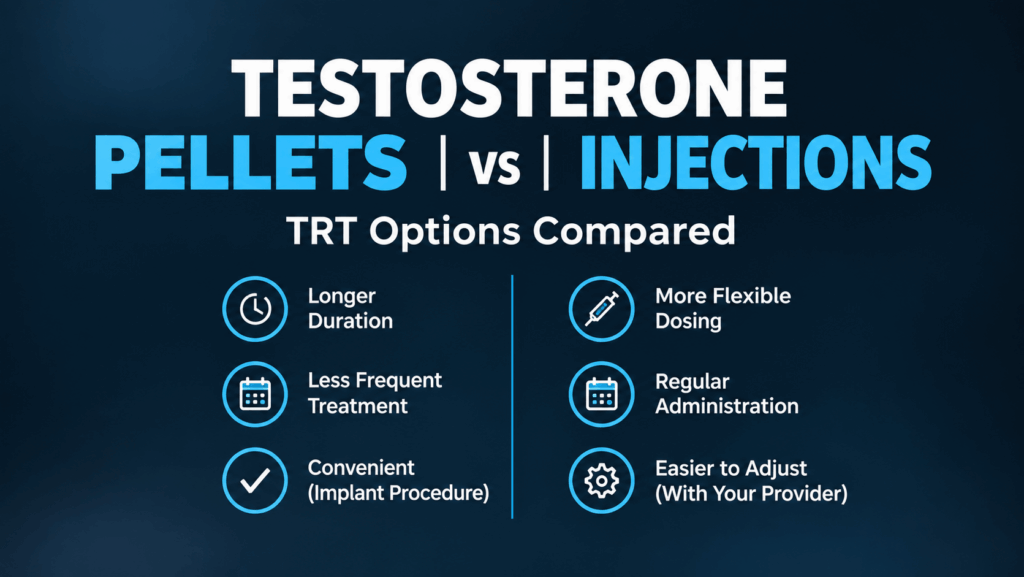
Testosterone Pellets vs Injections: Which Is Right for You?
When researching testosterone replacement therapy (TRT), two options that frequently come up are testosterone pellets vs injections. Both approaches can deliver testosterone to the body, but they differ significantly in how they are administered, how long they provide treatment, how they are monitored, and what practical considerations patients need to understand.
Testosterone therapy is not appropriate for everyone with a low testosterone result. Current Endocrine Society guidance emphasizes that hypogonadism should be diagnosed in men who have compatible symptoms and consistently low testosterone measurements, with an appropriate evaluation to identify the underlying cause.
This guide compares testosterone pellets and injections to help readers understand the differences and have a more informed discussion with a qualified healthcare professional.
If you are also researching treatment options, you may find our internal guide on testosterone for bodybuilding useful.
What Is Testosterone Replacement Therapy?
Testosterone replacement therapy is medical treatment intended to restore testosterone levels in people with appropriately diagnosed testosterone deficiency.
Testosterone can be administered through several delivery methods, including injections, gels, patches, buccal products, nasal preparations, and implantable pellets. The Endocrine Society’s patient information provides an overview of these treatment options.
The appropriate option depends on several factors, including the underlying cause of testosterone deficiency, treatment goals, preferences, cost, tolerance, fertility considerations, and the need for ongoing monitoring.
It is therefore not simply a question of which treatment is “stronger.” The more important question is which medically appropriate option fits an individual’s circumstances. view our article on Understanding CPT Codes for Testosterone Therapy
What Are Testosterone Injections?
Testosterone injections deliver testosterone into the body through an injection, generally administered either by the patient or a healthcare professional depending on the formulation and treatment plan.
Different injectable testosterone products have different pharmacokinetic profiles, so the frequency of administration can vary. Explore our full range of Injectable Steroids.
One potential advantage is flexibility. A clinician can adjust the treatment plan based on symptoms, laboratory results, and how the patient responds.
However, some people may experience fluctuations in testosterone levels or symptoms depending on the particular formulation and timing of administration.
The Endocrine Society lists injections as one of the established testosterone-treatment options and notes that some formulations are administered every one to two weeks, while certain longer-acting formulations are administered less frequently in clinical settings.
What Are Testosterone Pellets?
Testosterone pellets are small implants placed beneath the skin by a healthcare professional.
Instead of requiring regular injections, pellets gradually release testosterone over an extended period.
The Endocrine Society describes pellets as being implanted under the skin approximately every three to six months, although the actual treatment schedule depends on the individual and the specific clinical situation.
One of the main practical differences is that pellets require a minor procedure for insertion. Once implanted, they do not require the patient to administer injections during the period in which the pellets are releasing testosterone.
Testosterone Pellets vs Injections: Key Differences
The easiest way to understand the comparison is to look at the major practical differences.
| Factor | Testosterone Pellets | Testosterone Injections |
|---|---|---|
| Administration | Implanted under the skin | Administered by injection |
| Frequency | Generally every few months | Depends on formulation |
| Procedure | Requires an implantation procedure | Requires injections |
| Convenience | Less frequent treatment | More frequent administration for some formulations |
| Dose adjustment | Less flexible after implantation | Generally easier to adjust between administrations |
| Site-related concerns | Implantation-site complications | Injection-site discomfort or bruising |
| Monitoring | Required | Required |
| Individual suitability | Depends on medical circumstances | Depends on medical circumstances |
Neither option is automatically better for every patient.
Testosterone Pellets vs Injections: Convenience
Convenience is one of the biggest differences.
Pellets may appeal to people who prefer not to remember frequent injections because the treatment is administered during a clinical procedure and provides testosterone over a longer period.
Injections can offer greater flexibility because the treatment schedule and formulation can be adjusted more readily by a healthcare professional.
For someone who dislikes needles, pellets may initially seem more convenient. However, pellets themselves require an implantation procedure, so they do not completely eliminate procedures involving needles or skin penetration.
Testosterone Pellets vs Injections: Dose Flexibility
Dose flexibility is another important distinction.
With an injectable treatment, clinicians can generally modify the treatment plan at subsequent administrations based on laboratory results, symptoms, and clinical response.
With a pellet implant, testosterone is released over an extended period. Once pellets have been inserted, changing the amount being released is less straightforward than modifying a future injection.
This makes appropriate treatment planning and monitoring particularly important when pellets are being considered.
Testosterone Pellets vs Injections: How Long Do They Last?
The duration depends on the specific formulation and individual response.
The Endocrine Society describes testosterone pellets as providing treatment over several months, with implantation generally occurring every three to six months.
Injectable testosterone can have shorter or longer dosing intervals depending on the formulation.
Therefore, patients should not assume that every testosterone injection has the same duration or that every pellet treatment lasts for exactly the same amount of time.
Testosterone Pellets vs Injections: Side Effects
Both approaches can produce adverse effects because the underlying medication is testosterone.
Potential concerns associated with testosterone therapy can include:
- Increased hematocrit or red blood cell count
- Changes in blood pressure
- Acne or oily skin
- Changes in prostate-related measurements
- Reduced sperm production
- Infertility
- Fluid retention
- Changes in sleep apnea risk in susceptible individuals
The specific risks depend on the patient, treatment, formulation, and clinical circumstances.
The FDA’s testosterone safety information states that approved testosterone products are intended for men with low testosterone associated with an underlying medical condition and that testosterone therapy requires appropriate consideration of benefits and risks.
Pellet-Specific Considerations
Testosterone pellets have some risks that are related specifically to the implantation procedure.
The Endocrine Society lists potential pellet-related problems including the pellet coming out through the skin, infection, bleeding, and the possibility that testosterone levels may decline toward the end of the treatment period.
This is an important distinction when comparing pellets with injections.
A person considering pellets should discuss both the benefits of less frequent treatment and the potential complications associated with implantation.
Injection-Specific Considerations
Testosterone injections have their own practical considerations.
Depending on the formulation and injection technique, patients may experience:
- Injection-site discomfort
- Bruising
- Local irritation
- Anxiety about needles
- Fluctuations in symptoms or testosterone levels
Some people prefer injections because they provide a familiar and adjustable treatment format, while others prefer to avoid regular injections.
Which Is Better: Testosterone Pellets or Injections?
There is no universal answer.
Testosterone pellets may be attractive for people who prioritize less frequent administration, while injections may be attractive for people who value greater flexibility between treatment administrations.
The right choice depends on factors such as:
- Confirmed diagnosis
- Treatment goals
- Medical history
- Current medications
- Fertility plans
- Preference for injections versus an implantation procedure
- Cost and availability
- Ability to attend follow-up appointments
- Response to treatment
- Laboratory monitoring
The Endocrine Society specifically emphasizes individualized treatment decisions and discussion between the patient and physician when selecting testosterone therapy.
Testosterone Therapy and Fertility
Fertility deserves special attention.
Exogenous testosterone can suppress the body’s natural reproductive hormone signaling and reduce sperm production.
The Endocrine Society recommends against starting testosterone therapy in men who are planning fertility in the near term.
Anyone who wants to preserve fertility should discuss this before starting testosterone therapy rather than assuming that changing from pellets to injections—or vice versa—will solve the problem.
Who Should Consider Testosterone Therapy?
Testosterone therapy should not be started simply because someone feels tired or because a single blood test shows a low result.
The Endocrine Society recommends diagnosing hypogonadism based on compatible symptoms and consistently low testosterone concentrations, with additional evaluation to determine the cause.
Symptoms of testosterone deficiency can overlap with many other conditions, including sleep problems, obesity, certain medications, psychological conditions, and other medical issues.
A proper evaluation helps determine whether testosterone therapy is appropriate.
Monitoring Testosterone Therapy
Regardless of whether a patient uses pellets or injections, monitoring is an important part of testosterone treatment.
Healthcare professionals may monitor factors such as:
- Testosterone levels
- Hematocrit
- Symptoms and treatment response
- Blood pressure
- Prostate-related health when appropriate
- Adverse effects
- Other laboratory markers based on the individual’s circumstances
The goal is not simply to increase testosterone. The goal is to treat appropriately diagnosed testosterone deficiency while balancing potential benefits and risks.
Frequently Asked Questions
Are testosterone pellets better than injections?
Neither option is universally better. Pellets provide longer-duration treatment with less frequent administration, while injections can provide greater flexibility in adjusting future treatment. The appropriate choice depends on individual medical circumstances and preferences.
How long do testosterone pellets last?
Testosterone pellets generally provide treatment for several months. The Endocrine Society describes implantation intervals of approximately three to six months, although treatment schedules vary between individuals.
Are testosterone injections more flexible than pellets?
Generally, yes. Injectable treatment can usually be adjusted at subsequent administrations more easily than an implanted pellet, which continues releasing testosterone after insertion.
Do testosterone pellets require a procedure?
Yes. Pellets are inserted beneath the skin by a healthcare professional.
Do testosterone injections hurt?
Some people experience temporary discomfort, bruising, or irritation at the injection site. The experience can vary depending on the formulation, injection technique, and individual.
Can testosterone therapy affect fertility?
Yes. Testosterone therapy can suppress sperm production and may impair fertility. Men planning fertility should discuss this with a healthcare professional before beginning treatment.
What is the best testosterone treatment?
There is no single best testosterone treatment for everyone. The appropriate formulation depends on the diagnosis, medical history, treatment goals, fertility considerations, preferences, and monitoring requirements.
Final Thoughts
The choice between testosterone pellets vs injections comes down to more than convenience.
Pellets can provide extended testosterone delivery with less frequent administration but require an implantation procedure and offer less flexibility once inserted. Injections can be easier to adjust over time but require repeated administration and may produce fluctuations depending on the formulation and treatment schedule.
Most importantly, testosterone replacement therapy should be based on an appropriate diagnosis rather than symptoms alone or a single low testosterone result. The Endocrine Society recommends confirming consistently low testosterone levels in men with compatible symptoms and evaluating the underlying cause before treatment.
If you are considering testosterone therapy, discuss the available formulations with a qualified healthcare professional who can evaluate your individual circumstances and determine which option is appropriate.
This article is intended for educational purposes only and does not constitute medical advice. Testosterone therapy is a prescription medical treatment and should be used under appropriate professional supervision.